
Hwaves-Neuro
Heat waves risks for neurodegenerative patients in different microclimatic areas
| Overview
Duration: 36 months
Budget: 167 026 euros
Scientific coordination:
Basile Chaix, Giovanna Fancello, Nemesis U1136 Inserm, IPLESP
Partners:
Fabrice Carrat, Jonathan Bellet, CLEPIVIR- Epidémiologie clinique des maladies virales chroniques, IPLESP
Marc Verny, Brain-C Lab, B2A-UMR 8256, CNRS – Sorbonne University (No funded by the Program)
| Context
Neurological diseases are major global causes of death and disability and a public health priority. Although the process of neurodegeneration naturally takes place during the normal aging process, it can be accelerated by various neurodegenerative diseases, such as Alzheimer’s disease (AD), Parkinson’s disease (PD), and dementia with Lewy bodies (LBD). AD, PD and LBD share interrelated symptoms and clinical signs such as body rigidity, bradykinesia, memory loss, depression, tremor, and psychological disorders, that may be exacerbated by environmental factors. While the rising prevalence of neurodegenerative diseases is extensively documented in the literature, the connection between global warming and the short-term impact of heat waves (characterized by brief periods of exceptionally hot weather spanning two to three days) on the worsening of AD, PD and LBD chronic conditions, remains unclear.
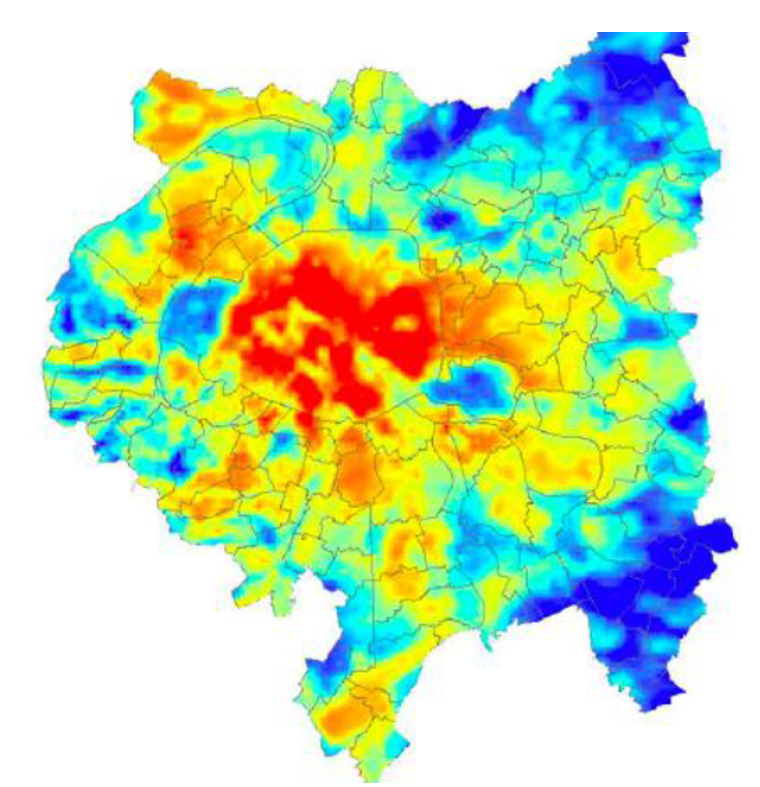
By the end of this century, the number of days characterized by heat waves in France will potentially double under the best circumstances and, at worst, could increase by a factor of 5 to 10. The phenomenon of warming is widespread globally, yet its intensity is not uniform when observed at various scales, ranging from the global level down to the local level. On a local scale, this variation in warming can be attributed to factors like urbanization, anthropogenic activities, land cover and urban morphology, all of which contribute to the formation of Urban Heat Islands (UHI).
In a climate change scenario, the combination of heat waves and UHI (urban heat islands) phenomena might lead to higher heat stress for disadvantaged populations with neurodegenerative disorders like AD, PD and LBD living in urban areas more sensible to warming. For example, in animal studies, it has been observed that hyperthermia can result in increased amyloid beta formation, the deposition of phosphorylated tau, and dysfunction in the blood-brain barrier. Therefore, factors associated with climate change, such as heat stress and air pollution, could potentially play a role in advancing the progression of neurodegenerative conditions and increasing the likelihood of emergency admissions to hospitals and post discharge death.
| Aims
The primary hypotheses of this study are as follows:
- Heatwaves have the potential to intensify the symptoms of neurodegenerative diseases such as AD, PD, and LBD, consequently elevating the risk of emergency department visits, hospital admissions, and mortality
- Microclimatic factors, which are influenced by particular urban attributes (greenness, urban density, …), may amplify these effects, particularly for patients residing in urban areas characterized by the urban heat island phenomenon
- Air pollutants may act as interaction terms within these associations, further influencing the exacerbation of neurodegenerative symptoms and outcomes
| Methods
Patients with AD, PD, LBD identified in the French health database (SNDS) for the period from 2012 to 2021 will be analysed. Two complementary statistical methods ((1)a cohort design with a mixed-level logistic regression model and (2) a case-only design taking the subject as their own control) were employed to investigate potential associations between heatwaves and the risks of emergency department visits, hospitalization, and mortality among AD, PD, LBD patients. The moderating role of residential urban environmental factors (population density, air pollution, etc.) on the associations between heatwaves and this risk will also be analysed. For both designs, we will apply distributed lag nonlinear models to examine the nonlinear and distributed lag effects of meteorological variables on the outcomes. This model will allow to assess over how many days before the day in question high temperatures are associated with the risk of an outcome (i.e. emergency access, hospitalization) and whether there is a delayed effect.
| Perspectives
This project will produce relevant knowledge for prevention actions on the individual exposures to specific factors of urban vulnerability to heat. Also, the assessment of different time lag exposures to heat and environmental stressors (and particularly air pollution) will produce knowledge about the required exposure time to be at risk for patients with AD, PA and LBD and related dementia living in different urban areas.
The project has several originalities. First it will evaluate which meteorological measure offers the best predictive ability on the risk to access to emergency departments, hospitalisation and death. Then it will assess in which microclimatic urban zone this risk is amplified. Also, instead to examine variations in meteorological conditions on a monthly or seasonal basis, various time lags of exposure, ranging from one day to one month, will be examined.
 Programme d'impulsion